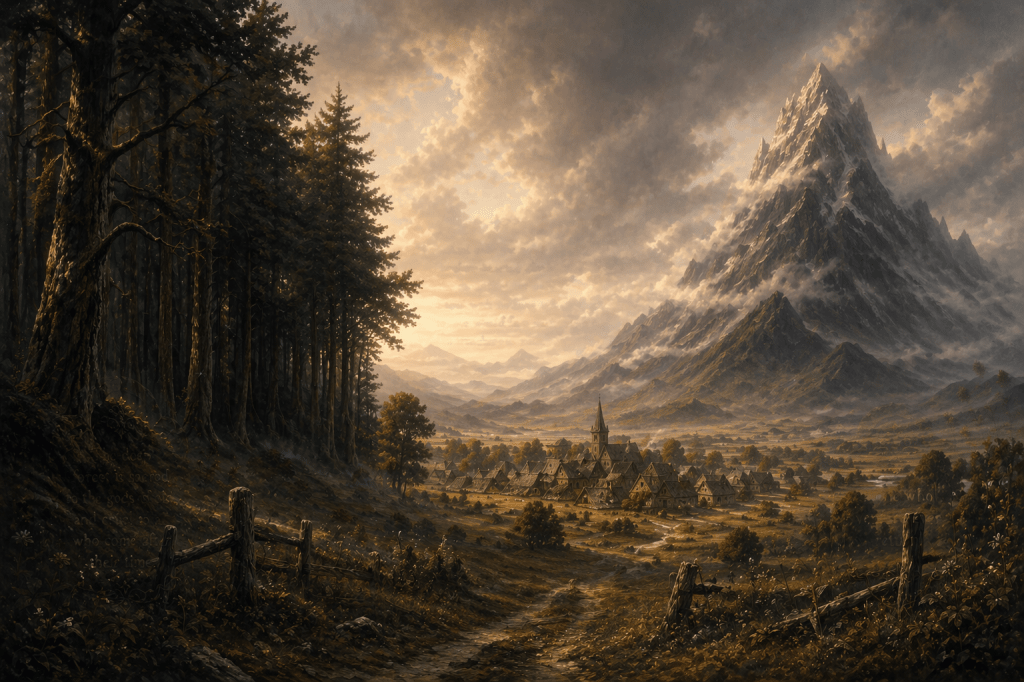
Long ago, when the world was still young enough for mortals to remember the gods, a small village stood in the plains between two places humans feared.
To the east lay an ancient forest. The outer woods were familiar ground, but the deep forest, where sunlight thinned to nothing, was forbidden by custom. It was said to be sacred to the gods of old, and cruel to all who came after their time.
To the west stood a solitary mountain, stark against the sky, its summit often veiled behind slow-turning clouds. Few stories were told of it, for its terrain was deadly. None who ventured ever returned.
The elders spoke of these places in low voices. They said only the bravest wandered deep into the forest where light vanished, and ghosts moved through the branches. And only the most broken-hearted climbed the mountain, for only a soul with nothing left to lose would face such a treacherous path.
Among the villagers lived a young girl who was neither brave nor broken, but curious. She often wandered through the woods and returned with leaves tangled in her hair, soil beneath her fingernails, and apron pockets heavy with acorns, feathers, and bits of dry grass that caught the light as she walked. In time, people began to call her Sylva, after the ancient goddess of the wild. The earliest legends say the goddess carried light with her, but was not meant to be sought.
Sylva’s twelfth year found dark times throughout the village. The harvest failed early as wheat grew brittle in the fields. Wells began to dry, and sickness drifted through cottages like leaves on a wind. Neighbors stopped lingering in the streets, and doors closed early. The village grew hushed with caution.
Sylva kept to the woods. It had never seemed unkind to her; rather, it had kept her company since she was small–first in games among the shadows, and later as a companion, listening when she felt no one else would. The woods was different from the plains–it was alive. The air moved slower there, like it breathed to an ancient rhythm, and the earth seemed to carry a faint pulse. Trees stood tall but left space between them, their roots coiling through the earth like resting serpents. Moss spread across the ground in soft green patches, carrying the scent of damp leaves, while birds and small creatures stirred above.
One afternoon, a sound like a long, drawn-out exhale came not from above, but ahead. It was too light for an animal, but too steady for the wind. She followed it as it led her between the dark yew trees and crooked pines, along a narrow path half-hidden beneath fallen leaves, drawing her deeper where the trees crowded and light thinned.
Sylva slowed as she realized she had gone further than intended. But when she stopped, the sound stopped. When she stepped forward, it began again.
For the first time, the woods did not feel the same.The air no longer breathed as it had before. The ground’s rhythm faltered. She had been warned not to venture too far.
She stepped back, but the sound came again–just ahead. Sylva hesitated. The woods had never led her wrong. It felt as though it wished for her to follow. So she continued. The deeper she crept, the dimmer the world became. Sounds thinned, then vanished. Even the scent of the earth faded, leaving only her breath and the steady beat of her heart.
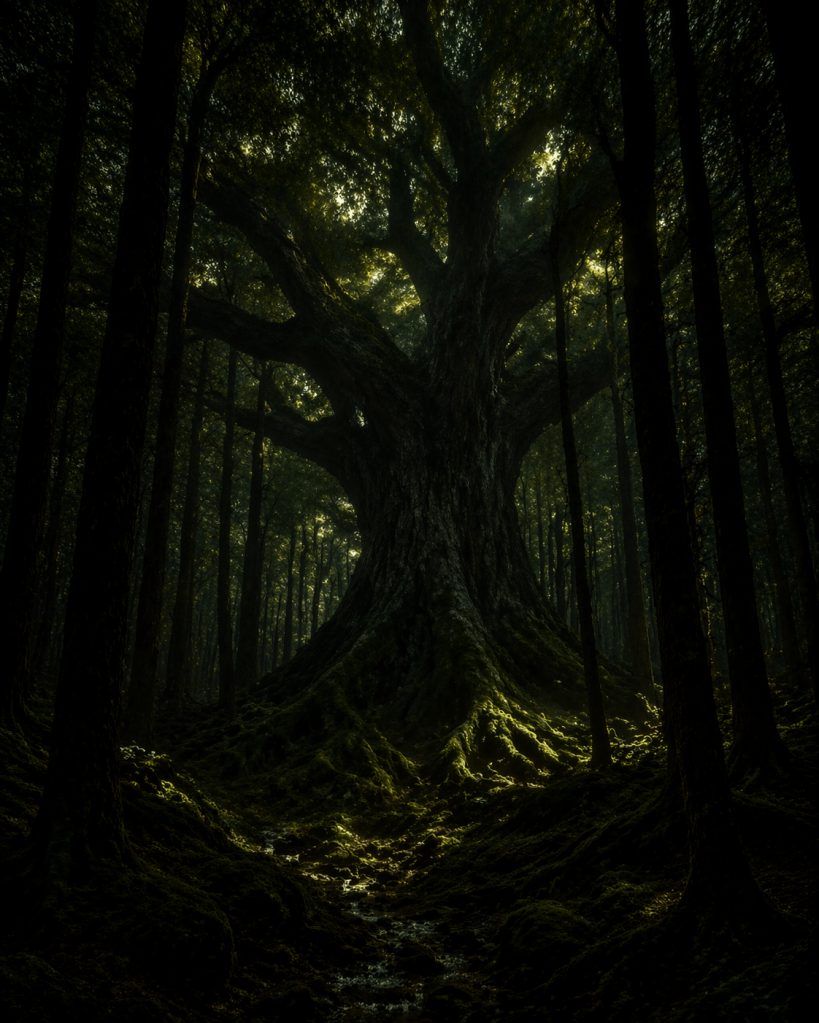
She slowed as the trees rose higher around her, their crowns lost above. Ahead, a single oak tree towered over them all–vast and ancient. The other trees stood at a distance, as though unwilling to press closer. Only a faint light reached the ground there, slipping through in uneven patches and shifting as if stirred by a wind she could not feel.
The sound she had followed was gone. There was nothing here. Sylva lingered a moment, then turned to leave.
Come.
At first she thought it was a gust of wind, slipping through the path behind her. But the sound lingered. It curled softly around her neck and brushed against her ear: Come to me.
“Hello?” She called, searching the shadows.
Higher.
Sylva lifted her gaze, following the great oak tree before her. Only then did she see its full size–its trunk wide enough that several men might fail to encircle it, its bark dark and twisted with age. Its roots lifted from the earth in winding ridges; its branches spread wide into the dim green canopy.
Sylva narrowed her eyes. “The tree is too high. The light is too dim.”
You must climb.
A pause as the words settled slowly within her.
Climb, the voice returned softer now, as though easing her forward, it calls to you.
Sylva placed her hands against the rough bark, her fingers tightening. It was warm to the touch. Before she could stop herself, she climbed. The tree seemed to lift her as she moved. Its ridges curved beneath her hands and feet like tiny steps.
As she rose, the air grew lighter. The scent of sap deepened as leaves and moss brushed her face. Light grew clearer, and she realized that this tree did not narrow to a crown, but split apart– five wide, heavy, distorted branches scattered upward. She pulled herself onto the fork between them.
And then she saw it.
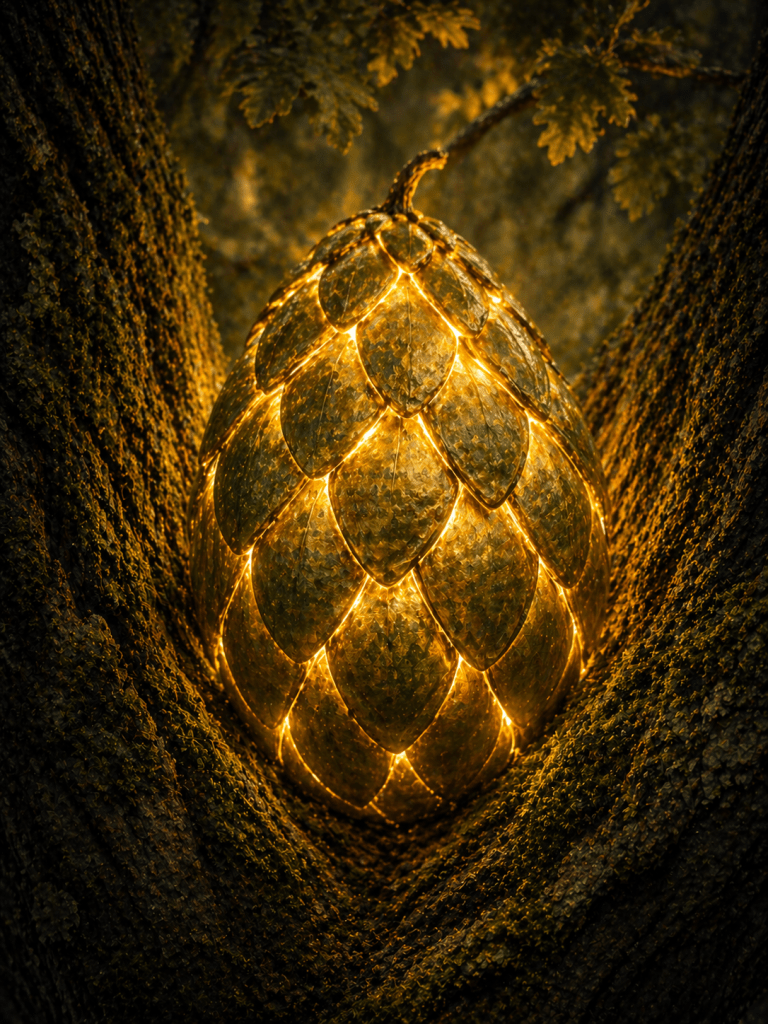
Resting in the crook of the oak was a fruit unlike any she had ever known. It was large–too large to fit easily in her hands–and shaped in a rounded, uneven form, as though grown in layers rather than whole. Its surface was made of overlapping segments, like scales or thick petals pressed tightly together. They curved outward just enough that each could be taken in a single bite. Their color shifted between deep green and deep gold. From within, a faint light pulsed through the seams.
Sylva stared at it in silence.
The whisper returned gently: Eat, and fortune will follow you.
She exhaled softly, “What is it?”
No answer came.
Magic existed in the stories her mother told her and her brothers beside the hearth. Stories of the days of old, the ancient gods, the forest and mountain. Those stories rarely had happy endings.
Yet the fruit stirred something within her. It reminded her, strangely, of a heart. Full and whole, bearing both the dark green of the woods and deep gold of the sun. Both always seemed gentle to her.
And it smelled remarkably sweet. Richer than honey, deeper than apples left to ripen in autumn. The scent filled her lungs and brought water to her mouth.
Eat, the voice commanded.
Slowly, Sylva reached forward and lifted the fruit. It was hot in her hands. A steady pulse pressed against her palms, then spread through her arms and into her chest until it took hold of her breath. Her heart faltered, then matched its rhythm. Light grew brighter all around her. She felt something grand and vast rising within her. The scent deepened, drawing her closer.
Eat. It was not a spoken word now, but a plea that rang through her body.
She leaned in and took a bite.
Sweetness burst across her tongue at once, overwhelming, like tasting every fruit that had ever grown beneath the sun. But the flavor turned as quickly as it came, thinning and drying until it left the taste of bitter bark and dirt in her mouth.
Sylva lowered the fruit. Its heat had cooled, and its glow had dimmed slightly. Where she had bitten, the flesh had turned black.
She glanced around her, but all was silent.
“If this truly brings fortune,” she whispered, “then let me have water.”
The words had barely left her when she heard a sound below. A sudden rush. A break in the earth. A splash.
Sylva turned and climbed down in haste. Bark scraped against her skin as the leaves caught in her hair, yet she persisted. When at last her feet touched the ground, she stilled.
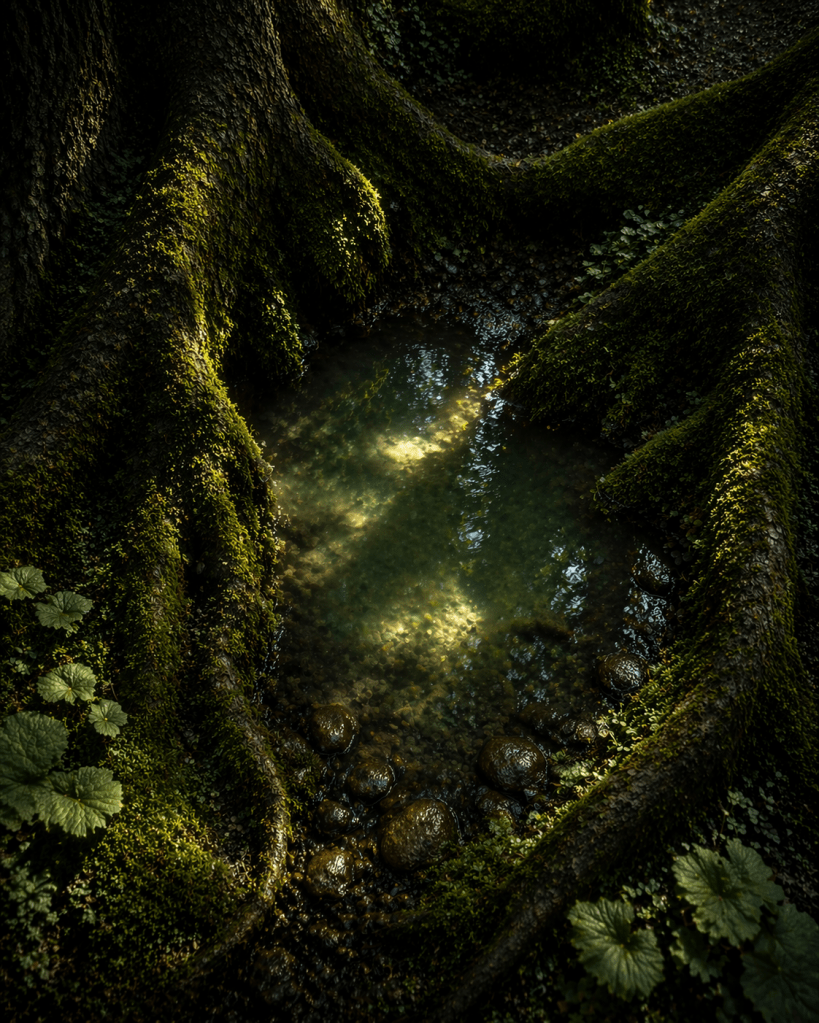
At the base of the oak, where the soil had been dry, a patch of water now lay between two great roots. Its surface was clear like glass, holding the faint green light.
Sylva dropped to her knees, cupped her hands and drank. The water was cold and sharp, washing away the dryness left by the fruit.
She lingered there with swirling thoughts. Why had the woods brought her here now? But she did not dwell on it. Her mother would soon begin searching for her. Slowly, she stood and followed the narrow path back.
When she returned to the village, a gathering had formed at the far end of the road. A family stood near their well, their voices strained.
Sylva slowed as she passed.
“This well has been ours since the early days!” A woman cried, her voice breaking. “Water does not vanish so. It was full this morning–I swear it before the gods!”
A small unease stirred within Sylva’s chest. She said nothing, only quickened her pace toward her family’s cottage. But the feeling followed her. Through the night, it lingered–the sudden water beneath the oak, the empty well at the edge of the village. She told herself it could not be. Yet, she did not sleep.
When dawn broke, Sylva rose before the others. She dressed in silence and slipped from the cottage, returning to the forest.
She followed the path she remembered. The air thickened as she passed the narrowing trees, the dark green light returned in broken patches, and sounds faded.
The great oak stood waiting. And at its roots, the water remained.
Sylva climbed once more. The fruit lay rested in the crook–exactly as she had left it.
Sylva hesitated, then reached for it, drawn by a need to know its truth. She took a bite and said, “Bread. My family needs bread.”
Nothing came. No sound from the earth nor smell of warm bread filling the air. Sylva waited a moment longer, then descended. She told herself it had been a chance, nothing more, and returned to the village.
But when she stepped into her family’s cottage, a basket of bread sat upon the table. The loaves were still warm, their scent filling the room. She moved toward them, drawn by hunger and wonder.
“Sylva,” Her mother’s voice called from the other end of the room.
She turned too quickly. Fear passed over her face at being found out of the cottage so early. “Mother, I’m sorry. I did not see you there, I was…”
Her mother stepped toward her, her expression troubled rather than stern, “How did this bread come to us,” she asked slowly, “when we have neither flour nor coin for such things?”
Sylva hesitated before answering. “Perhaps the forest heard me,” she said softly. “Perhaps the trees wished to help us.”
Her mother looked at her with worry. “Be careful with such thoughts,” she said. “The forest is far older than we are. Not all gifts are blessings.”
Sylva promised she would not ask for favors again. But she knew, even as she vowed, she would do no such thing.
She returned to the forest. Again and again.
Each time, the fruit answered her. Rain came when the fields had begun to fail. Food filled her family’s shelves when there had been none. Small fortunes appeared where there had been want.
Yet each time, something else was lost. Milk turned sour as it was drawn. A goat was found stiff in the morning frost. A child fell ill without warning.
At first, she turned from it. Coincidence, she told herself. But the pattern did not break.
One evening, Sylva caught sight of a blackened shape along a distant road–what seemed to be an old home. She hurried toward it and found a woman kneeling in ashes before the ruin. Her hands were pressed into the ground, her head lowered as though she could not bear to look at what remained. No cry escaped her–only a quiet, broken, unending sound.
Sylva stood still. The weight of it took hold of her: the fruit in the tree, the gifts it gave, and the cost that followed. Her mother had been right.
She remained a moment longer, watching the weeping woman in silence. There, in that agony, she vowed not to return to the tree again.
The years passed. The memory of the deep forest did not leave her, but it softened with time. By the spring of her seventeenth year, another love found her. His name was Alder.
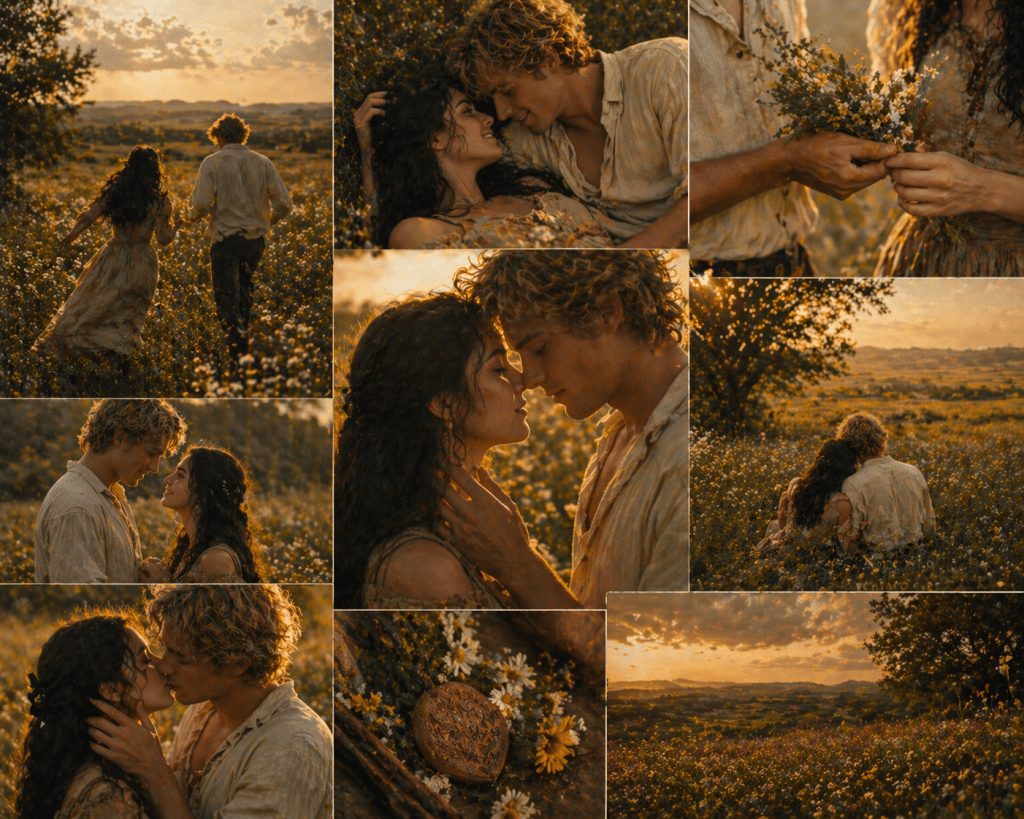
He was warmth, like the sun on a summer’s day. They wandered the plains together and found a meadow they made their own. There, they met often, speaking of what was to come–their hopes, their dreams, the life they would one day share.
“You don’t believe me,” he said once, smiling.
“I do,” Sylva replied, though hesitation traced in her smile.
Alder took her hand and placed it against his chest. “Then listen. I will build you a home of our own. I’ll set it on the edge of the village, so you can always hear the woods.”
With him, trust came easily. She had told him of the woods, of the way they had always felt to her, and he always listened with wonder. He walked her home in the evenings and lingered at her door. He brought her small tokens–wildflowers gathered from the fields, carved wood shaped by his hands. And on the evening of her eighteenth birthday, he kissed her.
His hand found hers, then her waist, drawing her tight against him. His warmth settled around her as the world seemed to fade away. When they parted, neither stepped back. They stayed there, sharing breath, her heartbeat rising between them. There, in Alder’s arms, she felt at home.
Until sickness came for him.
The fever struck quickly, burning through his body with terrible strength. Within days, his breath grew shallow and unsteady. The healer shook her head and whispered that death had begun its slow walk toward his bed.
That night, Sylva ran. She fled into the dark as though death’s chariot followed close behind. The forest opened to her. The half-hidden path rising beneath her feet as if by memory or pull. She did not slow.
The great oak stood in the dim wash of moonlight. She climbed with unsteady hands, tears falling as the leaves tangled in her hair and bark scraped her skin.
The fruit waited in the crook, as it had all those years ago.
Its golden glow reached her, and she paused. The woman in the ash came to her then–the bowed shoulders, the low, agonizing sound. The vow she had made.
Her hand faltered.
But beyond the trees, Alder lay fading. She saw it as though already done–his breath ceased, his warmth gone, the future they had dreamed left empty.
She reached for the fruit and held it in both hands. “Let him live,” she pleaded as she bit down. The fruit’s pedal was cold and hard as stone beneath her teeth. She forced herself to chew as a dry, earthen bitterness tinged with rust filled her mouth.
It was done.
Sylva drew back, breath breaking, and curled into herself among the branches, fear settling deep within her for what might follow.
Before morning came, she returned to the village.
Alder was no longer in his bed. He walked the streets as though sickness had never touched him.
She ran to him, and he caught her in his arms, holding her close.
After a moment, he drew back, his hand lifting to steady her chin. “You should go,” he said softly. “Before they wake and find us out of bed.”
Sylva nodded. They would meet in their meadow once the light had shifted. She hurried toward her home, thinking only of him.
But the door to her family’s cottage stood open. The air carried a sour scent, and a cold, heavy fear sank through her. She crossed the threshold and found her mother lying motionless on the floor. Sylva fell to her knees. Her scream broke the silence and tore beyond the walls.
In the days that followed, grief settled in her like trapped thunder. Her father drank himself into ruin. Her brothers grew hard and distant with anger. And through it all, Sylva waited for him. She thought he would come, stand beside her and break the silence her mother’s death left behind. But the days passed, and he did not. At first, she found reasons for his absence and held to the hope he would come. Then days turned to weeks.
His absence pressed into the wound her heart had become, until she began to give way. At last, on a cold morning, with frost clinging to the late autumn ground, Sylva went to him.
His door stood partly open. Inside, he stood close to another. His hands rested on her waist, drawing her near. A pale ribbon circled the woman’s wrist–the mark of their betrothal. Their mouths met. He pulled her close with an ease that struck deeper than the kiss itself, as though it were familiar to him. Her hands rose to his neck, holding him there as their closeness deepened.
Sylva turned at once. Her feet carried her blindly around the corner, her chest tightening until no air would come. The world tilted beneath her. She had thought herself already broken. But she had not known this. The pain in her broke, collapsing in on itself. No ache remained, no warmth. A hollow stillness settled where her heart had been.
She moved as if carried by a drifting wind. The woods had always been where she went when the world grew too heavy. But now, something deeper drew her, as though the path had been laid long ago. As though the forest was waiting for her.
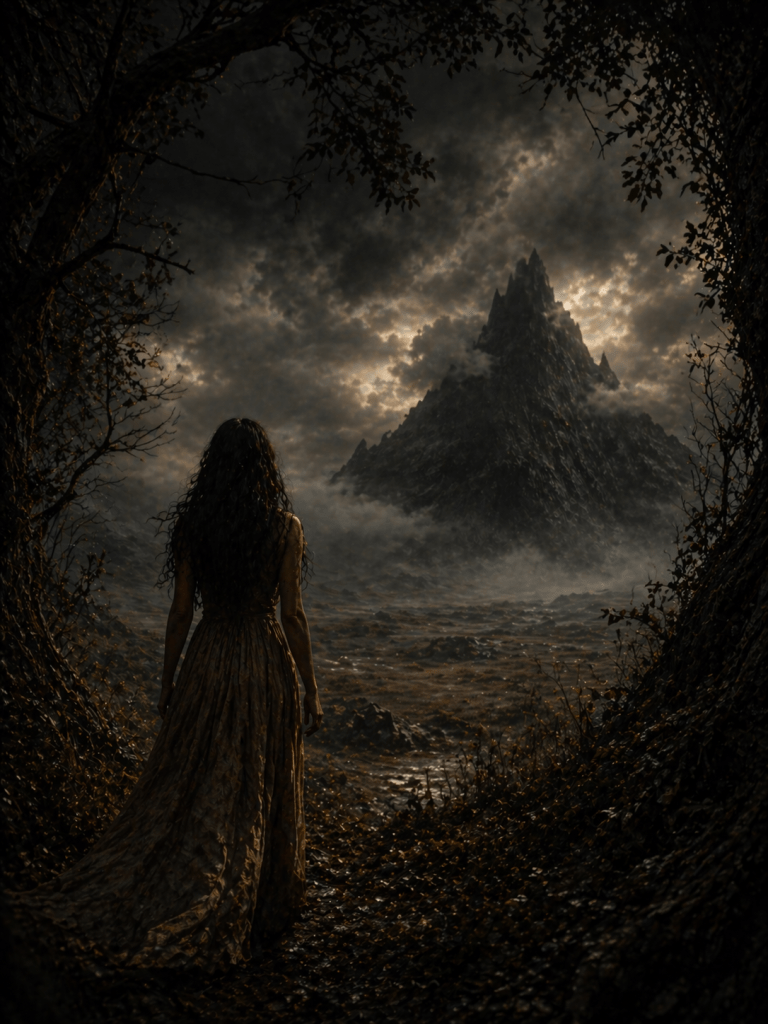
She did not feel the ground beneath her feet, nor the wind that moved through the trees. It was as though she floated through it all, untouched. When she reached the great oak, the climb came easily. And there, between the branches, rested the great fruit. Its flesh was no longer whole. Darkened portions marked where it had been taken before–childhood wishes, and one that had cost her dearly.
“Forgive me,” Sylva whispered as she reached for the fruit. “There is only one remaining request. And when it is done, we must not be here. I wish to be beyond finding.” She wrapped the fruit within her apron and began her descent.
The forest did not hinder her. The path shifted beneath her feet, opening where she stepped. When she emerged from the woods, she stood beyond the village’s reach and turned toward the lone mountain to begin her final climb.
The path was steep and cruel. Wind tore sharp across the mountainside, but she did not falter. By the time she reached the peak, the sky burned with the last light of day. The world stretched far below her, the village seemed no larger than scattered stones.

She stood alone and lifted the fruit toward the falling sun. “I wish,” she called against the wind, “that the man who betrayed me be met, in time, by all he has sown. Let this curse take root in his blood and pass through every life that follows him. Let all those who take fortune lose something dear in return.”
The voice from the forest returned, older now, and cold: Your curse will endure, but it demands a life.
Sylva closed her eyes. “I know.” Then she ate the remainder of the fruit, biting through its glowing center.
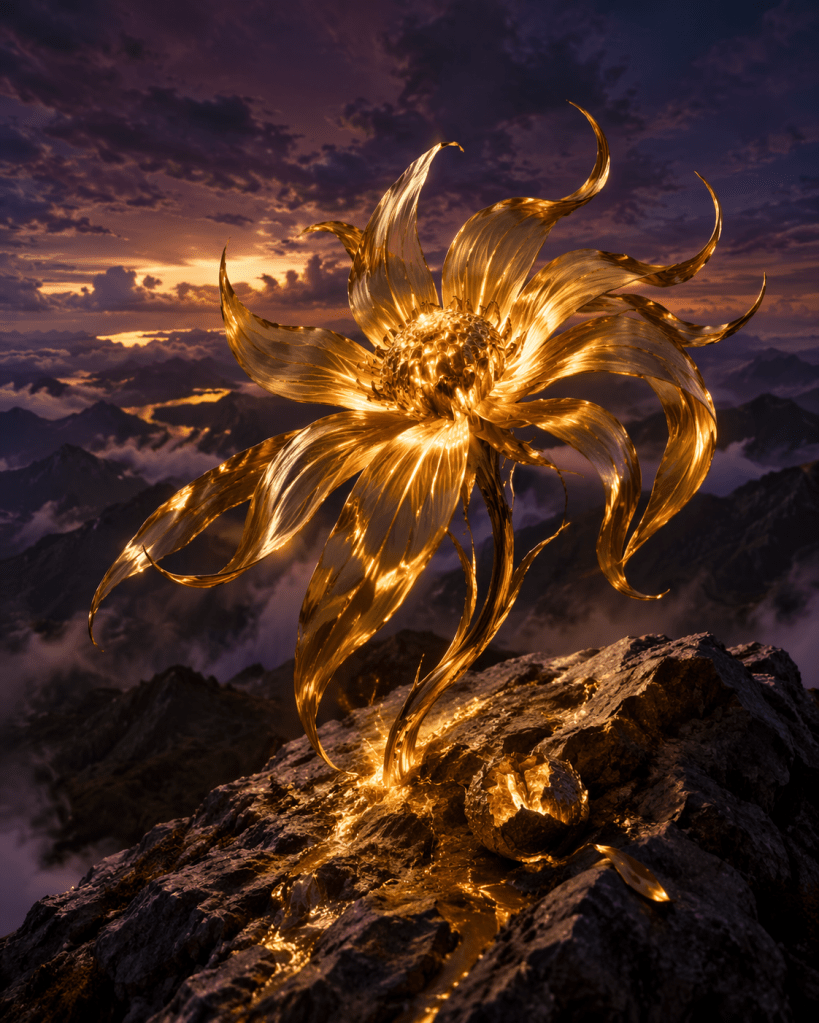
The change came slowly. Warmth rose within her as gold crept across her skin, dull at first, then brightening as its light grew. It moved through her like the veins of a leaf. Her feet rooted into the mountain stone, and her body was no longer her own. Her arms stretched toward the sky as her fingers unfurled into delicate petals that shimmered softly in the wind.
By the time the sun set, Sylva was gone. In her place stood a single, golden flower.
On clear nights, villagers began to notice a faint golden glow from the mountain peak. No fire could burn there, for no torch was ever carried so high. Yet the light always returned, unchanged.
In time, a new legend was born from whispers near the woods. They called it La Fleur d’Or. It was said to be a gift left by the gods of old, hidden at the summit. Whoever reached it, the story told, would be granted fortune beyond imagining.
Many believed it. Many tried. None returned. For the mountain was cruel to those who sought its treasure. Some believed that the gods scattered thorns along its paths. Others claimed the mountain’s air turned against those who climbed.
So the golden light continues to burn at the mountain’s peak–
Waiting.