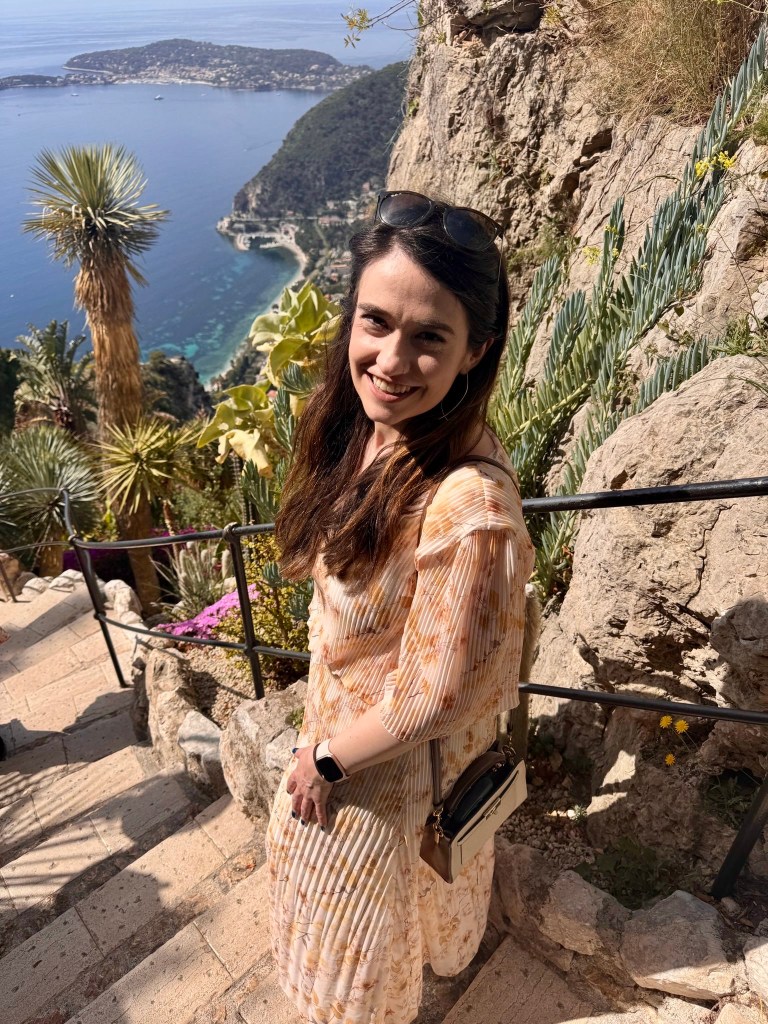
Several hundred stairs later, my lungs have filed multiple formal complaints and are considering mutiny.
“Who looked at a cliff and thought, ‘Let’s put a village there!’?” I ask, bending forward with my hands on my knees. “And, more importantly, why did they add stairs?”
Pierre laughs, genuinely entertained. “You’re almost there.”
The narrow street winds upwards between medieval, warm limestone buildings. My fingertips brush across the walls as we climb, the rocks are warm from lounging beneath the Mediterranean sun. Occasionally, bougainvillea drips from balconies in bursts of magenta.
Tiny shops crowd the alley. Scarves in shades of pastel pink, baby blue and lavender sway softly on merchant hangers. Somewhere nearby, dishes clink together. The smell of fresh bread wanders from an open doorway, followed by the sweetness of the flowers flourishing in the hanging baskets above. Otherwise, the streets are nearly empty.
In some places, the passage narrows enough that Pierre and I have to walk single file. In others, our shoulders skim as we squeeze between the stone walls.
We turn a corner and stop. At the end of the street stands a château carved from honey-colored stone.
For a moment, I simply stare.
Pierre notices my expression. “It’s nice, no?”
“Nice?” I repeat. “This looks like something from the fairytale books I read as a kid.”
His smile widens. “Come.”
A server greets us at the entrance before leading us through the cool corridors. Instead of the medieval charm of the village, the inside of the château feels almost Versailles-inspired with its emerald walls framed in gold. Glittering chandeliers are suspended from the ceiling, making the room feel suspended between history and luxury.
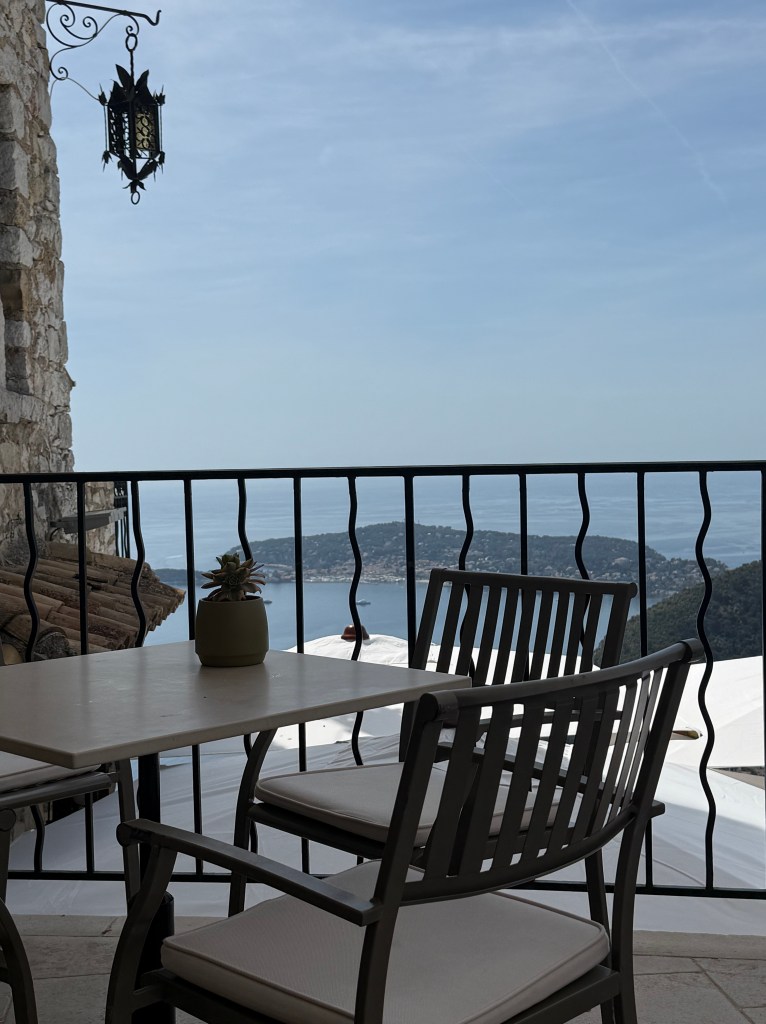
Then we step onto a terrace. I glance around, expecting tourists and crowded tables. Instead, we are completely alone.
The Mediterranean stretches endlessly below us in a watercolor of blues; primarily turquoise near the shore and sapphire farther out. Sunlight scatters across the water into thousands of golden ripples. A breeze brushes against my skin, carrying the scent of rosemary and thyme.
The waiter places two glasses of champagne in front of us and disappears. I reach for mine and turn to Pierre for a toast, only to find him already looking at me.
“What?” I ask.
“You stopped complaining.” He smirks.
I laugh and gesture helplessly toward the horizon. “How is this place real?”
Pierre leans back in his chair and follows my gaze. “I know. When you’re from here, places like this stop feeling special.”
“But not for you?”
“No.” He shakes his head. “Because we couldn’t come.”
I raise an eyebrow. “You’ve never said that before.”
“I’ve never really told you about my dad.” He lets the words linger between us before taking a slow sip of champagne.
“My parents separated when I was three, so I don’t remember them together. Charlotte does.” He gives a small, humorless smile. “She says he made my mother feel like she had four children instead of three.”
Pierre studies the stem of his glass. “Nothing was ever his fault. If she complained, he’d convince her she was overreacting. Eventually she left.”
I smile instinctively. “Good.”
“It was.” His expression softens with pride. “It was one of the bravest things she’s ever done.”
I think of Fabienne, whose kindness pours into everyone around her. The thought of anyone making her believe she was the problem fills me with anger. “He didn’t make it easy, though. Did he?”
He sighs. “In Arabic culture, divorce carries a lot of shame. A woman leaving her husband…” He gives a small shake of his head as he sucks in a breath. “So he punished her. He refused to pay child support.”
My eyebrows shoot up. “How could he get away with that?”
“He wasn’t supposed to.” Pierre shrugs. “Mom was too exhausted to spend years fighting him in court. She always said she’d rather lose the money than lose her peace.”
I look down into my champagne.
“So she worked. Two jobs. Sometimes three.” He smiles sadly. “There still wasn’t much left after rent.”
Pierre lets out a short laugh. “He bought Porsches while we suffered.” His jaw tightens. “While my mother skipped meals, he was living in penthouses and pretending we didn’t exist.”
For a long moment, neither of us speaks. I can’t understand how someone could stop caring about their own children. My stomach knots, and I shift in my chair, as though changing position might ease the discomfort.
Finally, he clears his throat. “I’ve realized something recently.” He rubs his hands on his knees gently. “I think I’ve spent most of my life trying to prove myself to him.”
His gaze drifts toward the coastline as he watches the waves below. “I kept telling myself that if I worked hard enough, got into the right school, made lots of money…” His voice trails off. “Then maybe my father would regret leaving us.”
“You didn’t have anything to prove.” I reach for his hand, waiting until he finally looks at me. “He walked away from people who needed him. You’re the guy who notices when someone’s hurting and does something about it.”
I squeeze his hand. “That’s who you are. Whether he sees it or not doesn’t change it.”
For a moment, he says nothing, his throat moving as he swallows. His fingers tighten around mine as he turns to face me. “Thank you.”
“I mean it.” I lean closer towards him. “My first day in Cannes, I was terrified.” I laugh softly. “But then you showed up.”
He tilts his head with a shy smile.
“You made this place feel less scary.” I gesture toward the view spread out below us. “When I think about France one day, of course I’ll remember places like this, but–” My eyes find his again. “Mostly I’m going to remember the people who made it feel special.”
The faint smile spreads wider across his face. “You shouldn’t sell yourself short,” He places his other hand over mine. “People open up to you because they feel safe around you.”
I feel warmth creep into my cheeks. I hesitate before asking the question that’s been on my mind for months. “Can I ask you something?”
“You just did.”
I roll my eyes. “You know what I mean!”
He chuckles. “Of course.”
We draw back our hands. “Why didn’t things work out with Colette?”
For a moment, he simply watches the boats drift across the Mediterranean. When he finally answers, his voice is calm. “Living together showed us who we really were.”
“Meaning?”
“We argued more than we laughed.” He shrugs. “About everything–dishes, money, time. We were becoming people neither of us liked.
“I think we were both embarrassed to admit we’d failed.” He pauses. “Then she cheated.”
There it is. I’d suspected it, but hearing him say it aloud still makes my chest tighten. “Were you surprised?”
“No.” His answer comes quickly. “I knew we weren’t right for each other. But it hurt because I made it, again, about my father.” He shakes his head. “It felt like proof. Like, eventually, everyone realizes I’m not enough.”
The words land deep inside me. “They don’t.”
He looks up.
“They don’t realize that.” I reiterate.
Pierre’s eyes flick toward something behind me. “I’m not so sure,” he murmurs.
The waiter arrives and places a wooden board with cured meats, cheeses, olives, and warm bread before disappearing once again.
I tear off a piece of bread. “That first night, when you told me my mom shouldn’t say those mean things to me.”
He nods, remembering.
“Anyone else would’ve laughed and told me I was overthinking it. Or that she didn’t mean it.” I meet his eyes. “But you didn’t. You made me feel like I wasn’t crazy.”
I shake my head. “You’re more than enough, Pierre.”
Tears gather in his eyes. Before I can think better of it, I reach across the table and rest my hand against his cheek. He leans into my touch. One tear escapes, and I brush it away with my thumb.
He lets out a shaky breath that almost sounds like a laugh. “Thank you.” He threads his fingers through mine, turns our hands over, and absentmindedly presses his lips to my knuckles. He lowers them back to the table, studying them. “Can I ask you something?”
“You just did.” I whisper, smiling.
He smirks. “Why didn’t it work out with Massimiliano?”
“You can call him Max, you know.”
“I’d rather not.”
I laugh as I consider the kindest way to put it. “We outgrew each other. I mean, we met when we were seventeen.” I shake my head. “That was the hardest period of my life.”
Pierre tilts his head. “Why?”
I let out a long breath. “My entire childhood, I wanted to be an actress. Or a director. Or honestly… anything to do with theatre.” I swallow. “When I was seventeen, my high school got a new theatre teacher…” My voice falters. “Who made theatre feel unsafe.”
A tear slips down my cheek. “Theatre was all I’d ever wanted. All I’d ever known. And he took it away from me.” As another tear escapes, Pierre wipes it away with his thumb. I turn slightly towards him. “Without it, I had no idea who I was. I went down a dark path.”
I shake my head, face down. “I’m ashamed of the person I became.”
“Rose,” Pierre says softly, the most sincere look in his eyes. “Who you were at seventeen isn’t who you are now.”
I shake my head. “You wouldn’t say that if you knew what I did. The people I hurt because I wanted someone else to hurt as much as I did. People who didn’t deserve it.”
He studies me for a long moment. “I would still say that because it’s true.”
“I told people things about Max I knew weren’t fair.” I force myself to keep looking at him. “I knew exactly what to say to make someone cry, and I’d say it. I lied–a lot. I became someone who wanted other people to hurt.”
I loosen my grip on our hands, expecting him to let go. Instead, his fingers tighten around mine. For a long moment, he studies my face, then our joined hands.
He slowly shakes his head. “Rose…” His voice is quiet. “I hate that you did those things.”
My stomach sinks.
“But you were hurting.” He says immediately.
Tears sting my eyes, and I blink hard to keep them from falling.
He waits until I finally meet his gaze. “I know how this story ends.” He leans in, his thumb brushing slowly across the back of my hand. “You looked at the person you were becoming…” A small smile tugs at the corner of his mouth. “And you stopped being her.”
He gives my hand another gentle squeeze. “That’s all that matters.” His eyes never leave mine. “The woman sitting here isn’t the girl you’re describing.”
I inhale a shaky breath and nod. “I think I’ll always carry that guilt, though.” I look back toward the sea. “I hate going home. I feel like everyone there still sees that version of me.”
“That’s why you chose Alabama instead of Mississippi.”
I nod. I steady my breathing. “University’s been great. A friend got me a job helping with a summer literacy program.” The corners of my mouth lift. “I loved it. Every second.”
I glance down at our hands. “So I majored in education… just to see if it felt right.” I smile a little wider. “And it did.”
“And Massimiliano was there through all of that?”
I nod. “He was.” My smile disappears. “And I hurt him.”
I sigh, turning back to the sea. “Like I said, we’d outgrown each other–even by the time we were eighteen. But we were young. Instead of ending it, we’d hurt each other in little ways. He’d chip away at me, and I’d hit back harder. But I stayed in that relationship anyway because…”
I slowly pull my hand back. “After…” I take a shaky breath. “After Mr. Dendy…” My voice almost disappears. “I think I honestly stopped believing I deserved to be loved.”
Silence settles between us. Pierre waits until I look at him. “Rose,” he says quietly, “if that’s what this theatre teacher taught you…” His hand finds mine again. “Then he was wrong.”
“But it’s how I feel, Pierre.” My voice rises without meaning to. “I feel like I deserved what Mr. Dendy did to me. Hurting Max–and seeing his reaction–became the only proof I had that someone cared. Even if the ‘care’ was hatred.”
Pierre’s expression tightens. “Did Dendy…” He swallows. “Did he ever… try anything with you?”
“No.” I shake my head. I take a deep breath and consider how to explain. “I think there are two kinds of pain: loud and quiet.”
“What’s the difference?”
“Loud pain is obvious.” I search for an example. “If someone punches you, everyone agrees you’ve been hurt. If someone steals from you, no one questions whether you’re the victim.”
He nods.
“Quiet pain is…” I stare out toward the sea. “A thousand tiny cuts instead of one deep wound. None of them seem significant on their own, so every time you ask for help, people tell you that you’re overreacting.”
His jaw clenches. “I see.”
I pause as I watch the waves crash onto the shore far below. The people on the sand look like tiny ants from far up here.
“I’ll always prefer loud pain.” I whisper. “Quiet pain makes you wonder if you’re crazy. Then, when you finally break, everyone points to your reaction instead of what led to it. It feels like a second death.”
I take a shaky breath. “Dendy was a master at quiet pain.”
My voice drops almost to a whisper. “In the beginning, he tried to get close to me, but something in my gut told me to stay away.” I blink back fresh tears. “When I wouldn’t do what he wanted like getting ice cream after school or staying late in the theatre to ‘help clean up,’ he’d convince the others to stop talking to me.”
“Fuck them,” Pierre mutters.
I can’t help the faint smile that escapes. “Agreed.” I sigh. “But I was seventeen. When you’re that age, your clique is your world. And mine disappeared overnight.”
“Rose, a teacher asking a kid to hang out after school is not normal.”
“I know.” I swirl my champagne glass. “He’d ask the same things of other girls, and they didn’t think anything of it. I’d tell them how uncomfortable it made me.” I swallow. “They’d tell him.”
Pierre closes his eyes for a brief moment.
“That’s when the little things started.” I shake my head. “A million tiny ways to make me question myself. He’d tell everyone rehearsal started at six except me. He moved my costume around on the rack. He started a rumor that I stole a prop.”
My fingers tighten into fists. “I reported him. I begged teachers, administrators and parents.” My voice cracks. “Every one of them decided I was the problem.”
I stare down at the table. “I know he never did this single, outrageous act, but–.” I shrug helplessly. “He did enough. Someone should have questioned why a seventeen-year-old girl suddenly felt so unsafe around a teacher.”
I let out a defeated breath. “They just… didn’t want to.”
Pierre leans in slightly. “What happened to Dendy?”
I laugh once, though there isn’t an ounce of humor in it. “The same thing that happens to the best con artists.” I look back toward the sea. “Nothing. He’s won teaching awards. National theatre competitions. Everyone loves him.
“Meanwhile, I’ve been exiled from my hometown.”
Pierre takes a moment, thinking. “This is why you studied abroad. Not because of Massimiliano.”
I nod.
“It’s why you wanted your internship abroad too.”
“Yeah.” I let out a weak laugh. “As much as Paris sucked, at least it was an ocean away from him. From all of them.
“He hurt me,” The tears come before I can stop them. “But they…” My voice breaks. “They hurt me even more.” I wipe quickly beneath my eyes, my hands starting to shake.
“These were people who’d known me as a little girl. Families whose backyards I chased butterflies through, whose guest rooms I left stuffed animals behind in.” I shake my head. “And they chose him.”
I turn toward Pierre, but I can’t bring myself to meet his eyes. “He’s a monster.” The words leave my mouth barely above a whisper. “I know he is.”
Immediately, Pierre slides his chair beside mine, then pulls me into his arms. “I believe you.” He pulls me tighter. “They should have protected you.”
The tears I’d been fighting finally win. I bury my face against his shoulder and let them fall. His hand moves slowly across my back in gentle circles.
Little by little, my breathing steadies and the tears begin to slow. I lean back, embarrassed by how soaked the shoulder of his shirt has become. “I’m sorry.” I rub at my eyes, grateful I didn’t wear mascara today.
“Please don’t apologize.” He reaches up slowly, brushing a stray tear from my cheek with his thumb. His hand rests lightly beneath my chin, his finger tracing the curve of my jaw. “I’d rather see you cry than watch you pretend to be fine.”
I swallow. Slowly, I lift my eyes to his. The silence between us feels different now. We’re closer than we’ve ever been. Close enough to make out the freckles scattered across his nose and the tiny strands woven throughout his eyes.
His thumb stops rubbing against my jaw. His gaze lingers on mine before dropping to my lips. Mine follows. My pulse stumbles. The world tunnels until there’s only him. Neither of us breathes. Before I can second-guess myself, I close my eyes and lean in.
“Àhem.”
We spring apart. Pierre straightens his chair with far more composure than I manage–I nearly knock the table sideways.
The waiter smiles politely. “Would you care to order dinner?”
Pierre looks at me.
“I am hungry,” I admit, “But maybe we could–”
“We’ll take the menus.”
The waiter nods and begins explaining the specials.
When he finally leaves, I turn back to Pierre. “This place looks expensive.”
“It is. And I’m paying.”
“Pierre–”
He holds up a hand. “I brought you here. It’s only fair that I pay.”
I fold my arms. “I can pay for my own dinner.”
“I know.” He says simply. “I just want to.”
We stare at each other again, not as close, but in the same way as before. Until he breaks away with a cough.
“So. If America reminds you of…everything” His voice is gentle. “Why are you so determined to go back?”
I take a slow breath, letting my eyes wander back toward the sea. “Honestly?” I shrug. “If it weren’t for Dendy… I don’t think I ever would’ve left my hometown.
“I love America.” I smile faintly. “Europe is incredible, but it’s complicated. Life back home could be… easy.”
He considers that for a moment. “Easy isn’t always the same as right.”
The corner of his mouth lifts when he notices my raised eyebrow. “My grandmother used to say that comfort and happiness are distant cousins. People confuse them all the time.”
He leans back in his chair. “She was annoyingly wise.” A laugh escapes him. “Or annoyingly good at copying other people’s wisdom.”
I narrow my eyes, fighting a smile. “What?”
His eyes brighten as his grin grows. “She’d hear a quote somewhere and spend the next twenty years claiming she’d made it up.”
“You’re kidding!”
“I’m serious!” He slips into an old woman’s voice. “Pierre, it’s like I always say…” He pauses dramatically. “Every man dies, but not every man really lives.”
I double over laughing. “You didn’t tell me your granny was William Wallace.”
“It’s the family secret.”
The waiter returns with our dinners, and the heaviness of the afternoon gives way to easier conversation. We talk about childhood memories, favorite foods, terrible movies, books we love–anything and everything. He knows my favorite flowers are edelweiss because I was obsessed with The Sound of Music as a kid. I know his favorite color is blue because it brought him peace when his childhood felt chaotic.
By the time the waiter clears our plates, the sun begins to settle behind the mountains. The ancient stone walls of the château gleam golden in the sunset, while the sea below slowly transforms from turquoise to sapphire. Somewhere overhead, birds call to one another, their songs carried by the breeze. I commit every detail to memory.
Èze will forever be the place where I became irrevocably in love with Pierre Amin.